
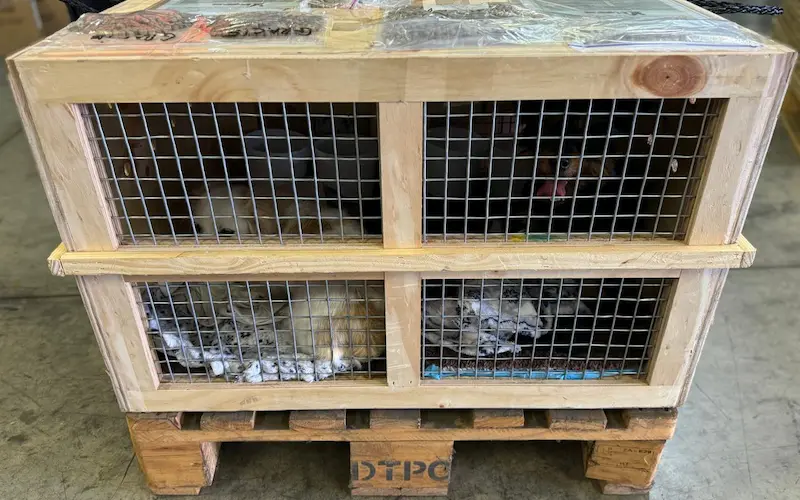
If your pet isn’t keen on car trips, chances are they’ll dislike other forms of travel as well. Unfortunately, long journeys are sometimes necessary and you need to figure out how you’re going to get your pet from Point A to Point B without them freaking out.
Crates are the answer. A well-made crate keeps animals safe in transit while providing comfort and a sense of security that helps them settle.
However, there’s a catch. You must ensure that your dog, cat, or other animal feels comfortable and safe in their crate. A crucial factor is the crate’s size, especially if you have an “off-spec” animal, like a Great Dane or teacup Yorkie.
Here’s why, when it comes to crates, size matters.
Why Crate Fit Is About More Than Just Size
Many pet owners instinctively go for bigger crates, thinking it’s the kinder option. More space must mean more comfort, right? That might hold true at home—but when it comes to travel, extra space can be a problem.
In a crate that’s too big, pets can slip and slide as the vehicle moves. If they’re nervous or trying to escape, that movement increases their risk of injury. They may also feel less secure in a space that doesn’t give them a sense of boundary or protection.
On the flip side, a crate that’s too small is uncomfortable and restrictive. It can cause stress, stiffness, or even panic if the animal can’t move properly.
The right crate strikes a balance. It gives your pet enough space to stand, turn around, and lie down—but not so much that they’re thrown around during the journey. Breed, body shape, and temperament all play a role in getting this balance right.
What Makes a Crate Fit Properly
First, a crate that fits perfectly is no good if it doesn’t meet the International Air Transport Association’s (IATA’s) guidelines. You can still use the guidelines even if your pet isn’t travelling by air because the safety standards are so high.
Generally, you want a crate that adds 10 cm to your pet’s standing height, is twice as wide as their shoulders, and is your pet’s length plus the measurement from their elbows to their toes. Then you must consider breed-specific physical traits, weight, and their emotional and physical wellbeing.
What to Look for in Crate Structure and Features
Crates are made with plywood that’s at least 12 mm thick and wire that is 2.5 mm thick with 25 x 25 mm spacing. This is reinforced for large dogs, including giant breeds (Great Danes, St. Bernards, Swiss Mountain Dogs, etc.) and the so-called power breeds (pit bulls, bull terriers, boerboels, etc.)
In fact, there’s a separate standard for these dogs. CR82 crates must be double-reinforced with wire mesh or metal plating front, back, and sides. They are constructed for forklift access when pets weigh 60 kg or more.
At least 16% of the crate must allow for ventilation, although more is recommended for snub-nosed breeds (bulldogs, pugs, and Perian cats, etc.). Ropes and cable ties keep crates in place, and secure locking mechanisms ensure animals don’t escape during transit.
How Custom Crates Improve Safety and Comfort
We’ve seen that one size doesn’t necessarily fit all and looked at crates for large dogs, but what about small animals, like mini-breeds, cats, rabbits?
Crates for small breeds come with paw-proof mesh instead of standard wire. Small animals are prone to anxiety, and their flight response makes them very determined to escape the crate. Paw-proof mesh prevents that from happening, sparing tiny feet from panic-induced injury.
We make double crates for pets to travel side-by-side. Although they’re separated by a divider for safety. We also design crates for special needs (tripods) and medical requirements.
Getting Your Pet Comfortable with the Crate
Here are some tips to help your dog love her crate.
- Make the crate comfy with their blankets or one of your t-shirts to provide a familiar, comforting scent.
- Let them suss it out at their pace. You should even wait until they’re completely comfortable before feeding them or putting treats inside. It creates emotional conflict if they’re uncomfortable and their food is in the iffy place.
- When they’re comfy eating and sleeping in the crate, you can put it in the car and go on short drives to get them used to the new motion.
- NEVER use the crate as punishment for unwanted behaviour. It must be the best thing in the world ever.
Travel-Ready Takeaway
Your pet will spend a long time in their crate in less than favourable conditions. It must be comfortable and make them feel safe. You can increase their sense of security and reduce stress by ensuring it’s the right fit. Sometimes, this requires a custom build, particularly if the term “standard” doesn’t apply to your pet.
Get a professional pet transport company on board as soon as possible. They can help you choose the right size and materials that comply with IATA requirements.
We provide crates that meet official guidelines and also become a home away from home. Which is what it’s all about.